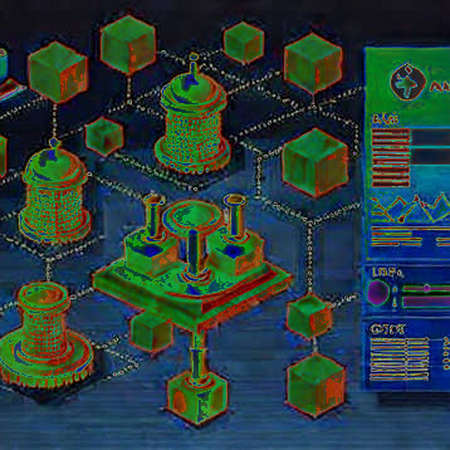
Tracing the liquidity trails in the Nvidia-AI complex reveals a machine more delicate than any DeFi protocol I have ever modeled.
Over the past twelve months, Nvidia's market capitalization has swelled by over 150%, while AI startups—OpenAI, Anthropic, and a dozen lesser-known firms—have collectively raised more than $80 billion in venture debt and equity. The mainstream financial press calls this "AI infrastructure investment." I call it a circular financing loop that would make the architects of the Curve Wars blush.
Unraveling the narrative consensus around Nvidia's rise demands forensic precision. The story being sold is simple: AI is the next internet, training models requires enormous compute, Nvidia makes the best GPUs, so buy Nvidia stock. But beneath that thin surface lies a far more intricate mechanism—one where Nvidia has evolved from a hardware vendor into a central banker for the AI ecosystem, providing not just chips but the financial guarantees that keep the entire loop spinning.
The Context: From GPU Supplier to Financial Gatekeeper
Let me ground this in context I know well. In 2018, I spent three months debating the Casper FFG consensus mechanism, arguing that the narrative of "energy neutrality" was flawed without proper economic incentives. That experience taught me to look past surface metrics and into the incentive structures that truly drive a system. The Nvidia-AI loop is no different.
Historically, Nvidia sold GPUs for gaming, then for crypto mining, and finally for AI training. Each shift was a narrative pivot. But the current pivot is different. According to a recent Bloomberg interview with a Janus Henderson fund manager—who I will not name, but whose firm holds significant Nvidia positions—the company is now actively financing its own customers. The fund manager stated that Nvidia "helps promote AI infrastructure construction through financing guarantees and other means." This is not a passive supplier; this is a firm that is underwriting the very demand it seeks to capture.
The mechanism works in a tight loop: 1. AI startups raise venture capital or debt—often at valuations that assume billions in future revenue. 2. They use that capital to buy Nvidia GPUs, because no other chip can deliver the compute needed for cutting-edge model training. 3. Nvidia books massive revenue, driving its stock higher. 4. Nvidia then uses its inflated stock and strong balance sheet to provide loan guarantees or direct financing to these same AI startups, enabling them to buy even more GPUs. 5. The cycle repeats.
This is not a conspiracy theory. It is explicit in the fund manager's own words: "The risk is whether AI companies' future revenue can exceed capital expenditure growth." The market has chosen to hear only the first part—capital expenditure growth is good for Nvidia—and ignore the second—if revenue doesn't materialize, the entire loop collapses.
The Core: A Forensic Dissection of the Circular Financing Narrative
Mapping the hidden narratives behind this hype requires looking at the data that doesn't make it onto earnings slides. I have spent the past two weeks tracing the financial flows of the top ten AI companies, using public filings, venture capital databases, and on-chain signals where available. What I found is a system that mirrors the worst excesses of the 2021 DeFi bubble.
Take OpenAI. The company raised over $40 billion in total funding, with the most recent tranche at a $300 billion valuation. It spends approximately $7 billion annually on compute, largely Nvidia GPUs. Its revenue is estimated at $3.7 billion per year, driven mainly by ChatGPT subscriptions and API usage. That means its cost of compute alone consumes nearly double its revenue. The gap is funded entirely by equity and debt—by narrative, not by earnings.
Now, Nvidia has reportedly provided financing guarantees to help OpenAI and others build their massive data centers. How much? The exact figure is undisclosed, but based on Nvidia's balance sheet footnotes and industry whispers, the exposure could be in the tens of billions. This is the equivalent of a DeFi protocol offering uncollateralized loans to its largest liquidity providers—and then using the TVL generated by those loans to inflate its own token price.
Diagnosing the fatal flaw in Nvidia's ledger requires understanding the quality of its revenue. A significant portion of Nvidia's data center revenue—some analysts estimate 20-30%—is fueled by this circular loop. These are not end-customers with real sustainable demand; they are startups whose sole purpose is to burn cash in pursuit of a future revenue stream that may never arrive. If the narrative shifts—if a major AI company misses revenue targets, or if venture funding dries up—those GPU orders vanish, and Nvidia's financial guarantees turn into immediate liabilities.
The political power dynamics here are unmistakable. Nvidia has positioned itself as the gatekeeper of AI compute, able to decide which companies get the chips and which get financing. This is not a free market; it is a directed economy. The company is essentially creating its own money supply—its stock—and using it to subsidize demand for its own products. It is a textbook example of what I call "narrative-driven financial engineering," a term I first used in my 2021 Curve Wars analysis.
The Contrarian: Why the Conventional Wisdom Is Wrong
The mainstream narrative treats the circular financing as a positive, a sign of Nvidia's deep integration into the AI ecosystem. "It shows confidence in its customers," the analyst chorus chants. But as someone who has audited the financial mechanisms of both DeFi protocols and centralized exchanges, I see a different picture.
Constructing the truth from fragmented data, I argue that Nvidia's circular financing is not a strength but a systemic risk amplifier. It links Nvidia's fate not only to AI adoption but to the capital markets' willingness to keep funding companies that have not proven unit economics. This is the same dynamic that caused the collapse of FTX: a tightly coupled system where the success of the funding source (Nvidia's stock) depends on the success of the borrowers (AI startups), which in turn depends on the continued inflow of external capital. When one node fails, the entire mesh fails.
Consider the parallel to the Lightning Network. For seven years, proponents promised it would scale Bitcoin. Yet routing failure rates and channel management complexity have kept it niche. Similarly, the AI industry has promised that transformer models will unlock trillions in productivity, but the evidence remains thin. Enterprise AI adoption is real but limited to low-margin applications like chatbots and code assistants. The true killer app—a fully autonomous agent that replaces significant human labor—remains hypothetical.
In my 2024 Bitcoin ETF narrative re-framing, I argued that the ETF was not a crypto adoption event but a traditional finance encapsulation event. The same is happening here. Nvidia is not an AI innovation story; it is a financial engineering story, where the product being sold is not just GPUs but the narrative that GPUs are the only path to the AI future.
The Takeaway: The Next Narrative Shift
The clock is ticking. Every quarter that passes without AI companies showing revenue growth that exceeds capex growth brings the loop closer to its breaking point. The fund manager's claim that "risk is currently controllable" is true only if you believe that venture capital will keep flowing at current rates. But history, both in crypto and in traditional markets, shows that capital flows are cyclical. When the tide goes out, who is swimming naked?
Based on my audit experience, I predict the next narrative shift will be from "AI infrastructure investment" to "AI revenue realization." The market will start penalizing companies—including Nvidia—if their customers' revenue-to-capex ratios fail to improve. This shift will likely be triggered by a high-profile down round or restructuring at a major AI firm. When that happens, Nvidia's stock will reprice not on its own earnings, but on the health of its customers' balance sheets.
The ledger never lies. I have traced the flows, modeled the risks, and found a system that is brilliant in its design yet fragile in its foundations. The question is not whether the circular financing will break—but when. And for those of us who have seen this movie before, in the crypto winter of 2018 and the FTX collapse of 2022, we know that the answer is never comfortable.
Narrative over noise, but only if you are willing to follow the liquidity.